
FACTORS THAT MAY BE INVOLVED IN THE MOSAICISM OF THE EMBRYOS : A RETROSPECTIVE STUDY
Siew Yin Yee and Kannappan Palaniappan
Sunway Fertility Centre, Tower D, Level 10, Sunway Medical Centre,
No. 5, Jalan Lagoon Selatan, 47500 Bandar Sunway, Selangor, Malaysia.
Email : [email protected]
Objective: To evaluate the factors that may be involved in the mosaicism of the embryos by looking into the maternal age, the embryo biopsy day, blastocyst stage, blastocyst grading and interoperator variability.
Materials & Methods: In a retrospective approach, data was taken from the year 2021 to 2024 in our centre from 689 patients who opted for the preimplantation genetic testing for aneuploidy (PGT-A) in their IVF/ICSI treatment. A total of 2771 blastocysts were screened for aneuploidy.
Results: Among all embryos screened, 41% were euploid, 36% were aneuploid and 23% were mosaic as shown in Graph 1. Our data was consistent with the literature of younger patients having more euploid embryos and older patients have an increased aneuploidy rate. Of all the mosaic embryos, the younger age cohort of 35 years old and below had significantly higher mosaic rate as compared to the older group and the mosaic rate decreased as the age increased (Graph 2). We then investigated whether the mosaicism was being influenced by the day of the biopsy being carried out (Graph 3), the stage of the blastocyst when biopsy was done (Graph 4) and the grading of the blastocysts (Graph 5). No differences were seen, and the data were not statistically significant. We analysed further into whether the skills of the embryologists performing biopsy had an impact on the mosaicism and it was not related to experience either (Table 1).
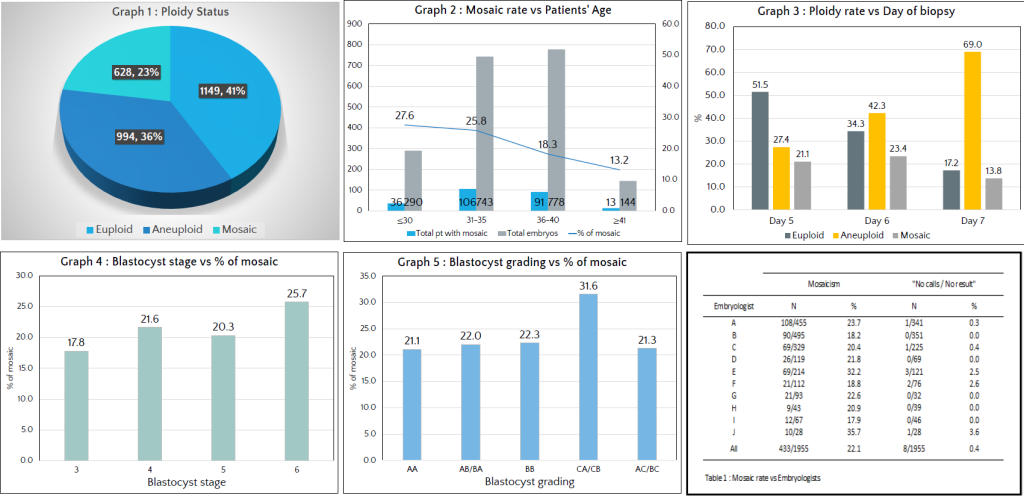
Conclusions: Based on our own patients’ cohort and data analysis done, mosaicism was overall higher in younger patients. Mosaicism generally was not associated with the day of biopsy done, blastocyst stage, blastocyst quality and biopsy operator.
Read & download the original paper here: