
Comparison of Clinical Outcomes between Intracytoplasmic Morphologically Selected Sperm Injection (IMSI) and conventional Intracytoplasmic Sperm Injection (ICSI) : A retrospective study
Siew Yin Yee and Kannappan Palaniappan
Sunway Fertility Centre, Tower D, Level 10, Sunway Medical Centre,
No. 5, Jalan Lagoon Selatan, 47500 Bandar Sunway, Selangor, Malaysia.
Email : [email protected]
—————————————-
Objective: To evaluate the differences between IMSI and ICSI in an unselected infertile patient population.
Materials & Methods: In a retrospective approach, data was taken from the year 2021 to 2024 in our centre from 889 IVF cycles with 246 couples underwent conventional ICSI procedure and 643 underwent IMSI technique – for fertilization and embryo utilization rate. We looked further at 542 cycles that opted for the preimplantation genetic testing for aneuploidy (PGTA) – a total of 2148 blastocysts were screened for aneuploidy. The final endpoint was studied at 362 cycles of FET-PGTA between the ICSI and IMSI group – for clinical pregnancy, miscarriage and live birth rate. Patients who had undergone testicular sperm extraction were excluded from the study.
Sperm were selected under x400 and x7000 magnification in ICSI and IMSI groups, respectively. Trophectoderm biopsy was performed on day 5 or 6 of development and PGTA was performed using next-generation sequencing (NGS). Clinical pregnancy and miscarriage were defined as the presence of the gestational sac after 6 weeks of gestation and pregnancy loss before 20 weeks of gestation, respectively. Statistical analyses were performed using the paired t-test.
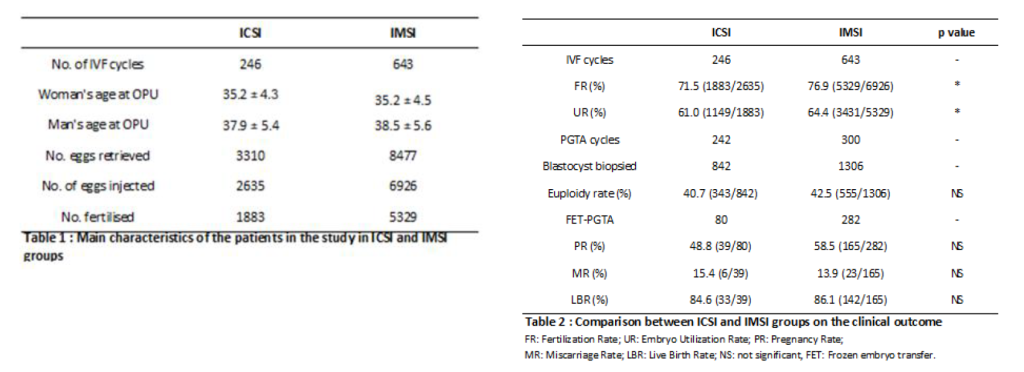
Results: The characteristics of the studied population (Table 1) were similar in both ICSI and IMSI groups when considering patients’ age, mean number of retrieved and injected oocytes.
The fertilization and utilization rate were significantly higher in the IMSI than the ICSI group (P < 0.05) while the rest of the cycle outcomes according to treatment modality as presented in Table 2.
There was no difference seen in the euploidy rate (ICSI: 40.7%; IMSI: 42.5%) and from the FET-PGTA data (ICSI:80 cycles; IMSI:282 cycles), the pregnancy rate (ICSI: 48.8%; IMSI: 58.5%) in the IMSI group was higher, but it was not statistically significant. Both groups were comparable when we investigated the miscarriage rate (ICSI: 15.4; IMSI: 13.9%) and live birth rate (ICSI: 84.6%; IMSI:86.1%).
Conclusions: Based on our own patients’ cohort and data analysis done, IMSI did contribute to the fertilization and utilization rate but in general, IMSI did not improve overall IVF outcomes in an unselected infertile patient population.
Read & download the original paper here: